 English

Views: 0 Author: Site Editor Publish Time: 2026-11-07 Origin: Site


The difference between a premium, high-contrast frosted engraving and a melted, hazy failure comes down to the chemical manufacturing process of the acrylic sheet. Fiber and diode lasers struggle with clear materials. However, the 10,600nm wavelength of a CO2 laser cutting and engraving machine is perfectly absorbed by acrylic. This makes it the undisputed industry standard for processing this substrate.
Operators frequently experience inconsistent engraving contrast, failed flame-polished edges, or warped structural assemblies. These issues lead to high scrap rates, wasted machine time, and compromised product quality. Understanding the distinct thermal behaviors, surface consistencies, and dimensional tolerances of cast versus extruded acrylic solves this. You must optimize parameters and maximize yield on your laser system to achieve professional results.
Engraving Contrast & Detail: Cast acrylic vaporizes under a laser beam, producing a high-contrast, frosted white mark that holds fine details perfectly, making it the "gold standard" for premium visual applications.
Cutting Efficiency vs. Edge Quality: Extruded acrylic melts rather than vaporizes, offering faster cuts at lower power, but it risks hazy edges if settings are incorrect. Cast acrylic provides a consistently clear, premium cut edge.
Dimensional Tolerance: Cast acrylic suffers from significant thickness variations (up to 30% across a sheet), complicating slot-and-tab assemblies, whereas extruded acrylic maintains strict dimensional accuracy.
Material-to-Application Match: Material selection must align with the primary operation—prioritize cast for visual engraving, fine typography, and edge-lighting, and extruded for high-volume, precision structural cutting.
Many operators mistakenly blame their equipment when acrylic projects fail. They adjust focus, clean lenses, and tweak speed settings endlessly. The root cause usually lies in the material itself. Cast and extruded acrylic look identical to the naked eye. They react entirely differently when exposed to intense thermal energy. Recognizing these differences stops predictable manufacturing failures.
Before loading a sheet into the machine bed, define the success criteria for your specific project. Different applications demand different material properties. A single type of acrylic rarely satisfies all production requirements simultaneously.
Define acceptable edge quality standards: Determine if the project requires a glass-like, flame-polished edge straight off the laser bed. Some structural parts only need a functional cut, where striated or slightly hazy edges remain hidden.
Establish engraving contrast requirements: Visual displays demand an opaque, frosted white mark for maximum readability. Industrial templates might only need a shallow, clear score line for part identification.
Determine dimensional accuracy needs: Structural assemblies, press-fit joints, and interlocking boxes require exact material thickness. Even a millimeter of variance ruins a complex 3D assembly.
Evaluate surface finish requirements: Premium awards require ultra-smooth, flawless surfaces. Utility parts tolerate standard extruded finishes with minor optical distortions.
By establishing these criteria upfront, you eliminate guesswork. You select the exact polymer formulation required to meet your production goals without wasting raw materials.
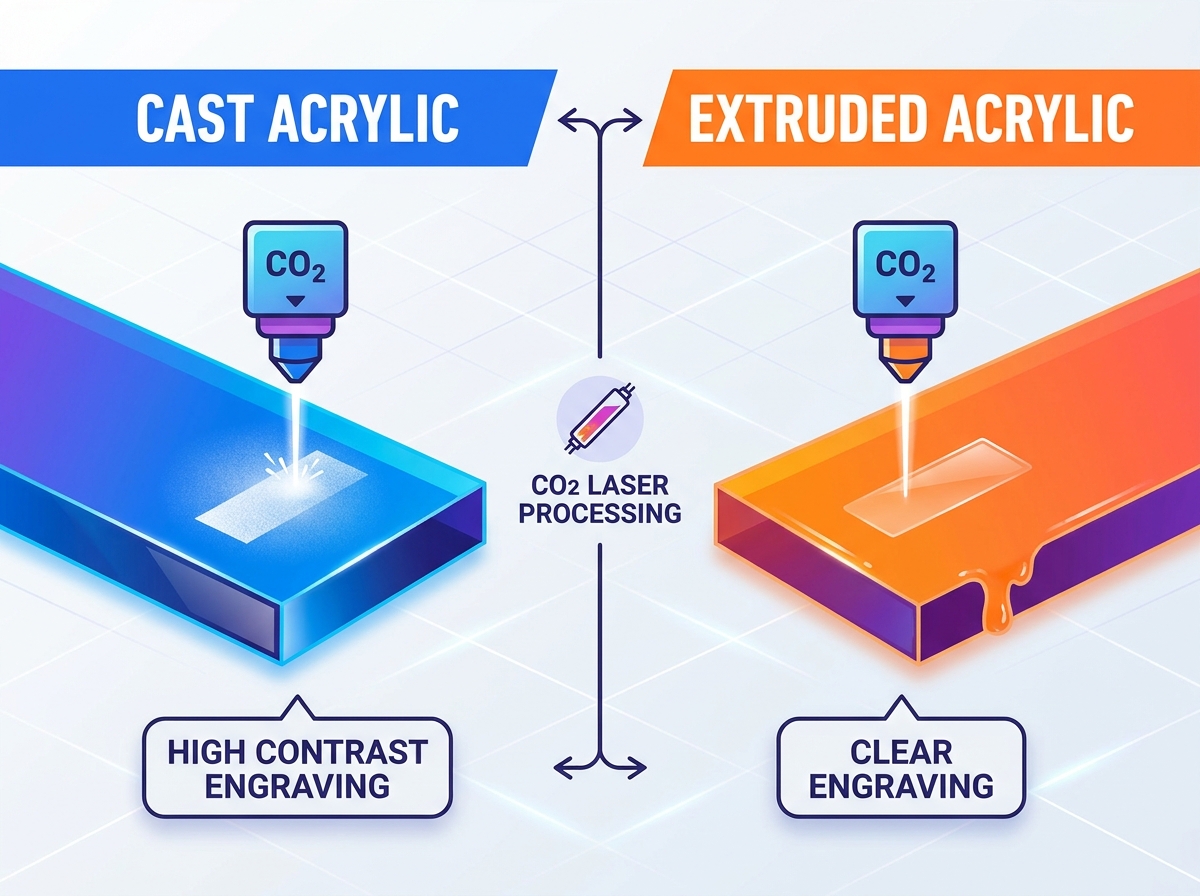
The physical properties of acrylic are permanently set during the manufacturing stage. The way Polymethyl Methacrylate (PMMA) transitions from a liquid resin to a solid sheet dictates its molecular structure. This structure governs how the material handles the concentrated heat of a laser beam.
Cell-cast acrylic is manufactured through a labor-intensive batch process. Liquid PMMA resin is poured between two highly polished panels of tempered glass. A rubber gasket seals the edges, creating a mold. The entire assembly enters an autoclave or heating oven. The resin cures slowly over several hours or days.
This slow curing process creates a polymer with a very high molecular weight. The long polymer chains cross-link extensively. This results in exceptional structural integrity. Because it cures against polished glass, cast acrylic boasts a remarkably smooth, premium surface finish with excellent optical clarity.
Thermally, cast acrylic behaves predictably under a laser. When struck by the high-energy beam, the material vaporizes instantly. It transitions directly from a solid to a gas. This clean vaporization prevents melted edges from bleeding into the design. It keeps kerf widths tight and details sharp.
Extruded acrylic relies on a continuous, high-volume manufacturing process. Solid PMMA pellets feed into a hopper, heat until molten, and force through a die. Mechanical rollers press the molten plastic into continuous sheets of specific thicknesses. The sheets cool rapidly as they move down the production line.
This rapid, mechanical extrusion results in a lower molecular weight. The polymer chains are shorter and forced into alignment by the rollers. This creates directional tension and internal stress within the sheet. The surface finish is good but lacks the flawless optical perfection of cast glass molds.
When exposed to laser heat, extruded acrylic melts before it vaporizes. The material pools and turns into a viscous liquid under the beam. As the laser head moves away, this liquid resolidifies quickly. If you do not extract the heat and fumes properly, this melting action causes localized warping, raised edges, and hazy residue along the cut line.
Engraving is where the molecular differences between the two materials become glaringly obvious. When evaluating cast vs extruded acrylic laser engraving, the visual output dictates the material choice entirely. You cannot achieve a premium frosted look on extruded stock, regardless of how you tune the machine.
Cast acrylic yields a bright, frosted white mark. As the laser pulses across the surface, the high molecular weight material micro-fractures and vaporizes cleanly. This rapid expansion and vaporization leave behind a highly textured, matte surface. This texture scatters ambient light. It creates a stark, high-contrast white appearance against the clear or colored background.
Extruded acrylic produces a clear, dull, or greyish mark. Because the material melts instead of fracturing, the laser creates a shallow pool of liquid plastic. When this liquid cools, it dries clear. There is no micro-texture to scatter light. The resulting engraving lacks contrast. It is difficult to read and visually unappealing for display purposes.
Cast acrylic is vastly superior for micro-typography and intricate artwork. The clean vaporization process means the heat-affected zone is incredibly small. Fine lines do not blur. The centers of small letters like 'a' or 'e' do not melt into a single blob. You can confidently run high DPI settings to achieve photographic quality.
Extruded acrylic struggles with fine details. The melting action causes the edges of the engraved areas to slump and fuse together. If you attempt to engrave small text, the heat accumulation turns the typography into an illegible, melted mess. The lack of crisp edges makes it unsuitable for detailed vector artwork.
Cast acrylic remains the industry standard for LED edge-lit applications. The frosted white engraving acts as a perfect light diffuser. When you inject LED light into the edge of the sheet, the light travels through the clear material until it hits the engraved texture. The micro-fractures catch the light and project it outward. This creates a brilliant, glowing effect.
Extruded acrylic fails at edge-lighting. Because the engraving is clear and melted, it does not interrupt the path of the light effectively. The light passes right through the engraved areas without diffusing. The resulting sign looks dim, uneven, and lacks the vibrant pop required for commercial displays.
While cast acrylic dominates the engraving category, the cutting category presents a more nuanced choice. Operators must balance edge aesthetics against production speed and dimensional accuracy. Each material offers distinct advantages depending on the final application.
Cast acrylic is the classic choice for a beautifully clear, polished edge directly off the laser bed. The vaporization process leaves behind a smooth, glass-like finish along the kerf. This eliminates the need for manual flame polishing with a torch. It saves significant post-processing time on premium displays.
To achieve that perfect flame-polished look on cast acrylic, you must balance speed, power, and frequency. A lower frequency setting allows the material to cool slightly between laser pulses, reducing the chance of boiling the edge. Conversely, extruded acrylic often requires a higher frequency to maintain a continuous melt pool, though this increases the risk of hazy edges if the feed rate drops.
Extruded acrylic can achieve a flame-polished edge, but it is highly sensitive to parameters. It requires precise feed rates, optimal focal lengths, and careful air assist management. If the laser dwells too long, the melted material boils. This leaves a hazy, white, or striated cut. If the air assist is too high, it cools the melted plastic too quickly. This creates a rough, cloudy edge. Achieving a perfect edge on extruded stock demands rigorous testing.
Extruded acrylic requires less laser power to cut. Because it has a lower melting point and lower molecular weight, the beam penetrates the material faster. This allows operators to increase feed rates significantly. In high-volume production environments where edge aesthetics are secondary, extruded acrylic maximizes machine throughput and efficiency.
When cutting thick extruded acrylic, lens selection becomes critical. A standard 2-inch focal lens works well for engraving and thin cuts. However, a 4-inch lens provides a longer focal tolerance, keeping the beam straighter through thick material. This reduces the bevel on the cut edge. Extruded acrylic responds well to this setup, allowing you to push feed rates higher without sacrificing edge squareness.
Cast acrylic demands more power and slower speeds to achieve a clean cut. The dense molecular structure resists the beam. It requires a slower feed rate to ensure complete vaporization through the entire thickness. This reduces overall throughput. It is less ideal for massive runs of simple geometric shapes.
Cast acrylic hides a significant flaw: thickness variance. Because it is poured between glass plates, the liquid resin shrinks unevenly as it cures. A sheet labeled as 3mm thick might measure 2.6mm in one corner and 3.4mm in another. This thickness variation makes press-fit joints, 3D structural boxes, and living hinges highly unpredictable. Parts cut from the same sheet may not fit together.
Extruded acrylic is the necessary choice for uniform thickness. The mechanical rollers press the material to an exact, consistent gauge across the entire sheet. If you are manufacturing slot-and-tab assemblies, interlocking displays, or precision mechanical enclosures, extruded acrylic guarantees that every joint will fit perfectly without manual sanding or adjustment.
Sometimes material arrives without clear labeling. You need a fast way to identify whether you are holding cast or extruded stock before committing to a large production run.
The Engrave Test: Run a small 1-inch vector square at high speed and low power. If the resulting mark is bright white and powdery, you have cast acrylic. If it is clear and slightly sunken, it is extruded.
The Smell Test: During cutting, cast acrylic emits a distinct, somewhat sweet, fruity odor. Extruded acrylic produces a sharper, more acrid, and heavy plastic smell.
The Edge Check: Look at the factory edges of the raw sheet. Cast acrylic often features rough, irregular edges from the gasket seal. Extruded acrylic usually has uniform, mechanically sheared edges.
Feature | Cast Acrylic | Extruded Acrylic |
|---|---|---|
Engraving Contrast | High (Frosted White) | Low (Clear/Melted) |
Edge Quality (Cut) | Premium (Glass-like) | Variable (Prone to haze) |
Cutting Speed | Slower | Faster |
Thickness Tolerance | Poor (+/- 10-30% variance) | Excellent (Uniform) |
Best Application | Awards, Edge-lit signs, Fine art | Enclosures, Templates, Box joints |
Material selection impacts the entire production workflow. Choosing the wrong acrylic type leads to hidden costs in the form of wasted machine time, ruined blanks, and excessive manual labor. You must evaluate the total return on investment rather than just the upfront material cost.
Extruded acrylic is generally cheaper to manufacture and procure. The continuous production process yields high volumes at a lower cost per square foot. This makes it ideal for prototyping, budget-sensitive runs, and disposable templates. When you need to iterate designs rapidly, extruded stock keeps material expenses manageable.
Cast acrylic commands a premium price. The batch manufacturing process limits supply and increases production costs. This upfront premium drastically reduces post-processing time. You eliminate manual edge polishing and scrap rates associated with poor engraving contrast. For premium applications, the higher material cost pays for itself through improved final quality.
To streamline shop floor operations, establish strict guidelines for material allocation. Use this framework to assign the correct acrylic type to incoming jobs.
When to choose extruded acrylic:
Prototyping structural enclosures and mechanical parts.
Manufacturing high-speed dimensional lettering for outdoor signage.
Creating jigs, fixtures, and router templates.
Producing slot-and-tab boxes requiring exact thickness tolerances.
When to choose cast acrylic:
Executing high-resolution photo engraving.
Processing intricate typography and fine vector graphics.
Manufacturing high-end corporate awards and trophies.
Producing LED edge-lit displays and custom illuminated signage.
Processing acrylic safely and efficiently requires strict adherence to material handling protocols. Both cast and extruded variants present unique challenges during and after the laser cutting process. Implementing proper mitigation strategies prevents ruined parts and maintains a safe working environment.
Extruded acrylic is highly susceptible to crazing. Crazing refers to a network of micro-cracks that form along the cut edge or engraved surface. Because extruded sheets contain internal directional tension, the heat of the laser amplifies this stress. If you clean a laser-cut extruded edge with isopropyl alcohol or harsh solvents, the chemical reaction instantly shatters the stressed edge. This ruins the part.
To mitigate crazing, mandate the use of mild soap and water for cleaning all extruded acrylic parts. Never use alcohol-based glass cleaners. If your application requires chemical exposure or gluing, you must anneal the extruded parts. Annealing involves heating the cut parts in an oven at a specific temperature and cooling them slowly. This relieves internal stress before applying solvents.
Protective masking prevents smoke damage and scratches during processing. The type of masking matters immensely. Plastic film masking on extruded acrylic often melts directly into the cut line. The laser heat fuses the plastic film to the melted acrylic edge. This creates a messy, welded burr that is nearly impossible to remove.
Paper masking is strictly preferred for all CO2 laser operations. Paper tape vaporizes cleanly alongside the acrylic, preventing edge-welding. Ensure your supplier provides paper-masked sheets, or apply standard transfer tape before cutting.
Ventilation requirements also differ. Vaporized cast acrylic produces a distinct, sweet-smelling white smoke that extracts easily. Extruded acrylic produces heavier, more acrid fumes due to the melting process. Ensure your exhaust system maintains sufficient CFM to pull these heavier fumes away from the lens and out of the cutting bed rapidly.
Operators face specific defects when running acrylic. Use this troubleshooting matrix to correct common issues on the fly.
Defect Observed | Likely Cause | Immediate Fix |
|---|---|---|
Melted, fused engraving details | Using extruded acrylic for fine detail | Switch to cast acrylic immediately. |
Cloudy, white cut edges | Air assist pressure is too high | Reduce air assist to a gentle flow. |
Vertical striations on cut edge | Cutting speed is too fast | Decrease feed rate by 10-15%. |
Micro-cracking (crazing) after cleaning | Alcohol applied to stressed extruded edge | Clean only with mild soap and water. Anneal parts if gluing. |
Masking welded to the cut line | Plastic film masking left on during cut | Remove plastic film and replace with paper transfer tape. |
Neither cast nor extruded acrylic is universally superior. Successful acrylic laser processing depends entirely on matching the material's thermal behavior to the specific operation. Cast acrylic excels at vaporization, making it the undisputed champion for high-contrast engraving and polished edges. Extruded acrylic melts efficiently, providing tight dimensional tolerances and faster cutting speeds for structural projects.
Default to cast acrylic for visual engraving projects, fine details, and premium edge quality. Default to extruded acrylic for tight-tolerance structural cuts, interlocking assemblies, and volume runs. By respecting the chemistry of the material, you eliminate guesswork and guarantee consistent, professional results.
Audit your current project files to separate visual engraving jobs from structural slot-and-tab assemblies.
Test small material swatches from new suppliers to verify engraving contrast before committing to full production runs.
Standardize paper masking protocols across the shop floor to eliminate plastic edge-welding issues.
Update your material inventory labels clearly to prevent operators from mixing cast and extruded stock.
A: Look at the masking. Cast acrylic usually comes with a heavy brown paper masking. Extruded acrylic often features a clear or blue plastic film masking. If unmasked, check the edges. Cast sheets often have rough, irregular factory edges, while extruded sheets have uniform, mechanically sheared edges.
A: You are using extruded acrylic. Extruded acrylic melts under the laser beam and resolidifies clear. To achieve a high-contrast, frosted white engraving, you must switch to cast acrylic. Cast acrylic vaporizes cleanly to create a textured, light-scattering surface.
A: No. Clear acrylic is completely transparent to the wavelengths produced by fiber (1064nm) and diode (450nm) lasers. The beam passes straight through the material without marking it. A CO2 laser (10,600nm) is required because its wavelength is fully absorbed by the acrylic.
A: You are likely using cast acrylic. Cast sheets have a thickness variance of up to 30% due to the liquid pouring manufacturing process. For precision joints and structural assemblies, switch to extruded acrylic. It maintains a uniform thickness across the entire sheet.
A: Never clean laser-cut extruded acrylic with isopropyl alcohol, ammonia, or harsh solvents. The laser introduces thermal stress, and chemicals trigger instant micro-cracking known as crazing. Clean parts only with mild dish soap and warm water. For critical applications, anneal the parts in an oven to relieve stress.
A: Leave the masking on the bottom to prevent flashback damage from the honeycomb bed. For the top surface, remove the masking before engraving to achieve the best detail and prevent adhesive residue from melting into the engraved texture. Leave top masking on only when cutting to prevent smoke stains.
