 English

Views: 0 Author: Site Editor Publish Time: 2026-10-24 Origin: Site


Cutting aluminum brings unique hurdles to any active fabrication floor. The metal highly reflects light and rapidly dissipates heat across the sheet. These specific thermal traits easily disrupt laser operations. If you choose the wrong fiber laser cutting aluminum assist gas, you face serious manufacturing problems. Poor selection leads to stubborn dross. It leaves sharp micro-burrs along the cut line. This poor finish forces your team into expensive manual grinding and secondary processing. Selecting the correct gas directly solves these frustrating issues. It controls the edge metallurgy instantly. It optimizes cutting speed. It ultimately drives your operational profitability. This guide provides a detailed decision-stage breakdown. We evaluate the critical tradeoffs between different gas types. You will discover how to prioritize clean finishes and maintain high throughput. We also align gas delivery methods with your daily production requirements. Read on to master gas selection for flawless aluminum parts.
Nitrogen is the industry standard for achieving dross-free, weld-ready edges on aluminum, acting as an inert shield against oxidation.
Compressed Air offers the lowest operational cost and high cutting speeds but leaves an oxidized edge requiring mechanical deburring before welding or finishing.
High gas pressure and strict purity levels (99.99%+) are critical to clearing molten aluminum before it solidifies as dross.
Aluminum acts quite differently than mild steel or stainless alloys. It conducts heat rapidly. The heat dissipates fast across the metal sheet. Aluminum also features a notoriously low melting point. This specific material combination makes the laser's melt pool highly volatile. You must control this volatility to achieve a clean cut.
The assist gas performs a crucial mechanical job inside the cut zone. It must forcefully eject molten material from the kerf. The gas pushes this liquid metal out before it cools. If the metal cools too fast, it adheres to the bottom edge of the sheet. Industry professionals call this hardened residue dross. Removing dross takes significant time and ruins production efficiency.
You must carefully evaluate how the gas interacts alongside the laser beam. We define the ideal gas by examining its chemical interaction. Some gases react exothermically. They add extra thermal energy to the cut zone. Other gases remain completely inert. Inert gases simply protect the cut zone from atmospheric oxygen. Your choice dictates the final part quality. It defines whether your part needs secondary grinding or goes straight to shipping.
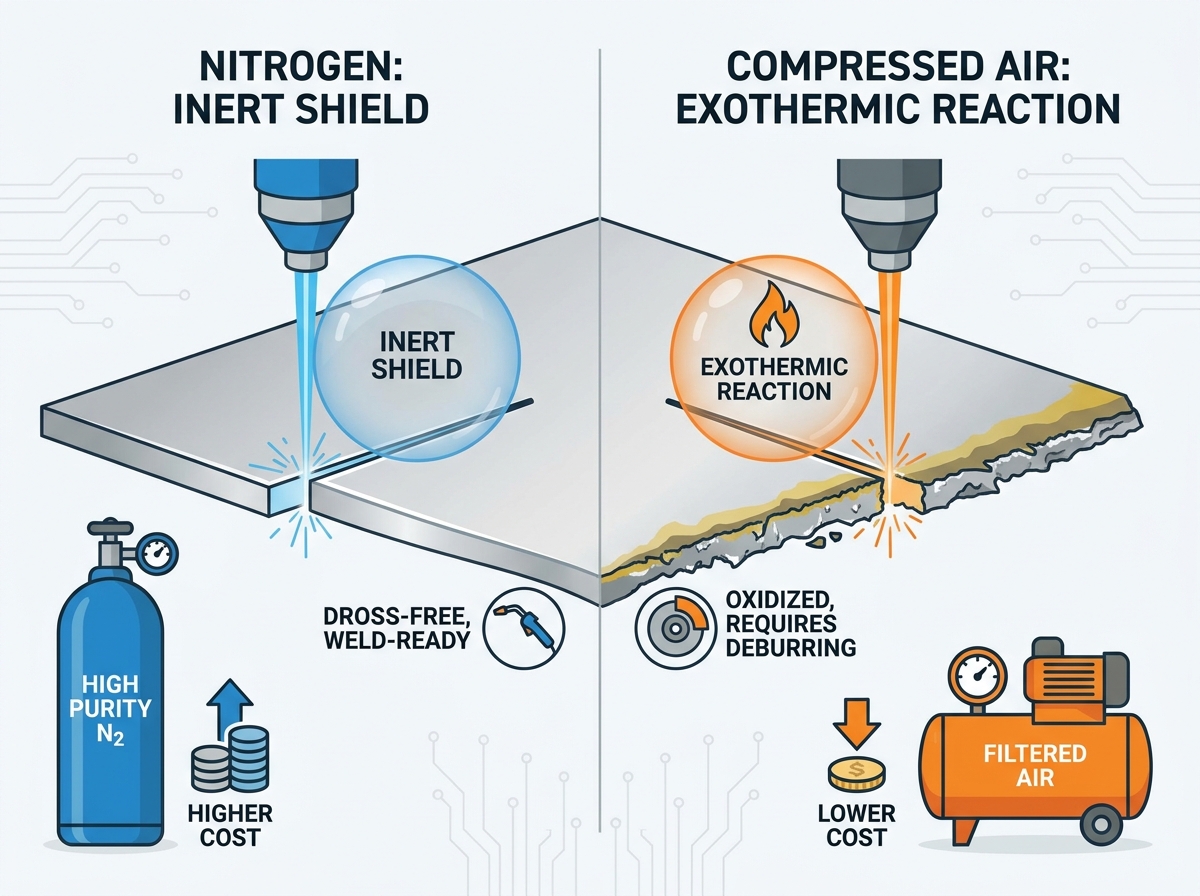
Fabricators face a strict choice between two primary gases. You must weigh nitrogen vs air laser cutting aluminum based on your specific shop needs. Each gas alters the physical and chemical state of the metal edge.
Nitrogen operates as a fully inert shielding gas. It cools the cut zone immediately upon contact. It forcefully blows away molten metal. Most importantly, it prevents any chemical reaction from occurring during the cut.
This process leaves a remarkably clean, silver edge. The cut remains completely dross-free. You can send these parts straight directly to the welding department. You can also powder coat them immediately without extra prep work.
However, nitrogen has notable operational drawbacks. It carries the highest gas consumption rate. It drives up your hourly operational expenses significantly. It also requires specialized high-pressure delivery systems. Shops must invest in robust gas infrastructure to support continuous nitrogen flow.
Compressed air contains roughly 78% nitrogen and 21% oxygen. The oxygen content creates a fast exothermic reaction. It contributes extra heat directly to the cut zone. This extra heat increases your cutting speed. It works exceptionally well on thinner aluminum sheets. It also significantly lowers your daily gas expenditures.
The main drawback involves the final edge finish. Air leaves a noticeable oxidized layer. This oxidized layer carries a yellow or brown tint. It also forms jagged dross along the bottom edge. You must grind this off before TIG or MIG welding. Otherwise, the weld suffers from severe porosity. This porosity weakens the structural integrity of the entire joint.
You might wonder about using pure oxygen. Pure oxygen creates an uncontrollable exothermic reaction on aluminum. The metal burns too rapidly. This causes severe edge burning. It blows out incredibly wide kerfs. It ultimately results in unacceptable part quality. We strongly advise against using pure oxygen for any aluminum cutting application.
You must tune specific machine parameters to achieve a perfect finish. Maintaining superior aluminum fiber laser edge quality requires extreme precision. Even the best gas fails if your machine settings are incorrect.
Aluminum needs significantly higher gas pressures than mild steel. Operators often set pressures between 15 and 20 bar for nitrogen. High pressure effectively shears the viscous molten material. It forces the liquid aluminum out before it solidifies. Low pressure leaves heavy burrs behind.
Purity dictates the final edge color and weldability. For true dross-free edges, nitrogen purity must remain above 99.99%. Even tiny trace amounts of oxygen degrade the finish. Poor purity causes unwanted oxidation. Monitor your gas supply closely. Change inline filters regularly to maintain consistent purity.
You must match the correct nozzle diameter to your material thickness. Fabricators use specific single or double nozzles for aluminum. Maintaining the optimal standoff distance is equally critical. This precise distance keeps the gas flow laminar. Laminar flow cuts cleanly. Turbulent gas flow scatters the molten metal. This turbulence creates severe burrs and rough edges.
Set the focal point strictly at the bottom of the material. Sometimes, you should set it slightly below the bottom surface. This specific focal position ensures a wide enough kerf. A wider kerf allows the high-pressure assist gas to pass through effortlessly. If the kerf is too narrow, the gas chokes. This choking effect traps molten metal inside the cut.
Best Practices for Edge Quality:
Inspect your nozzle tip for spatter before cutting aluminum.
Perform a tape shot to guarantee perfect beam alignment.
Start with manufacturer-recommended feed rates before increasing speed.
You must evaluate your gas strategy carefully. Do not evaluate gas costs in a vacuum. You should compare the hourly cost of nitrogen against the labor burden of deburring. If you cut using air, workers must manually grind every part. This manual labor often costs more than the gas itself.
Your chosen supply method heavily affects daily operations.
Cylinders and Dewars: These units work well for low-volume shops. They require minimal upfront investment. However, they remain prone to sudden pressure drops. Operators must stop production frequently to swap tanks.
Bulk Liquid Tanks: These tanks represent the ideal choice for high-volume users. They provide stable pressure all day long. They reduce the per-unit cost of nitrogen. You must sign long-term vendor contracts for these tanks.
On-Site Generators: Air compressors and nitrogen generators require high upfront capital. They demand dedicated floor space. However, they dramatically lower per-part costs over a 3-5 year timeline. They eliminate missed gas deliveries entirely.
Match the assist gas to the part's final destination. This simple rule saves thousands of dollars annually.
Use compressed air for internal structural components. Air works great for rapid prototyping. It perfectly suits parts undergoing heavy subsequent machining. The oxidized edge does not matter if a CNC mill removes it later.
Use high-purity nitrogen for aesthetic exterior panels. Nitrogen is absolutely mandatory for aerospace components. Choose nitrogen for any parts moving directly to robotic welding cells. Robots cannot adapt to poor fit-up caused by jagged dross.
Assist Gas Evaluation Summary
Assist Gas Type | Edge Finish Quality | Cutting Speed | Post-Processing Needed? | Ideal Shop Application |
|---|---|---|---|---|
High-Purity Nitrogen | Clean, Silver, Dross-Free | Standard | No (Ready to Weld) | Aerospace, Aesthetic Panels |
Compressed Air | Oxidized (Yellow/Brown) | Fast | Yes (Grinding/Sanding) | Prototypes, Internal Brackets |
You need a clear action plan to implement these strategies. Follow these precise steps to refine your cutting process and boost output.
Audit Current Bottlenecks: Measure the exact hours your shop spends deburring aluminum parts per week. Find out how much manual labor costs your business. Track the wages, abrasive discs, and lost production time. This data reveals your true operational expenses.
Material Testing: Request test cuts on your specific metal grades. Aluminum alloys behave differently under the laser. Compare 5052 against 6061 using both nitrogen and air. Inspect the physical finish closely. Weld the test coupons to check for hidden porosity.
Infrastructure Check: Verify your current piping system. Check your compressor infrastructure thoroughly. Ensure they handle the required Cubic Feet per Minute (CFM) for continuous high-pressure operations. Undersized pipes cause pressure drops at the cutting head. This ruins the cut quality instantly.
Common Mistakes to Avoid:
Ignoring air dryer maintenance when using compressed air.
Using thin rubber hoses instead of proper high-pressure gas lines.
Failing to recalculate costs when production volumes double.
The best assist gas is always dictated by your downstream requirements. If edge quality and immediate weldability are paramount, nitrogen remains non-negotiable. It provides the flawless finish required by high-end clients. Conversely, if raw speed and operational cost are prioritized over finish, high-pressure air stands as the practical choice. Air keeps your machine moving fast and reduces immediate overhead.
Your next action is critical. Consult with your equipment manufacturer immediately. Determine the optimal gas delivery system based on your machine's wattage. Match the gas supply to your shop's daily aluminum throughput. Proper planning guarantees clean edges and highly profitable production runs.
A: No, provided your compressed air is rigorously filtered. You must use coalescing and desiccant dryers to remove all moisture and oil. Contaminated air will rapidly ruin your cutting head optics.
A: Not immediately. The oxidized edge and dross must be mechanically removed prior to welding. You must grind or sand the edge clean. Otherwise, the weld will suffer from severe porosity and structural weakness.
A: While it varies by material thickness and laser wattage, cutting aluminum generally requires high-pressure nitrogen. Operators typically set pressures ranging from 150 PSI to over 300 PSI (10–20+ bar) to cleanly evacuate the kerf.
A: Yes, for facilities cutting aluminum daily. Despite the initial capital expenditure, it eliminates volatile bulk delivery costs. It ensures consistent pressure and usually pays for itself within 12 to 24 months.
