 English

Views: 0 Author: Site Editor Publish Time: 2026-10-22 Origin: Site


Edge quality remains a critical profitability bottleneck in metal fabrication today. Secondary operations like grinding or deburring erode margins quickly. They slow down production lines and introduce frustrating inconsistencies. While modern machines offer exceptional speeds, stainless steel presents a unique fabrication challenge. Its high melt viscosity and complex thermal properties make it highly sensitive to minor parameter deviations.
Achieving a pristine fiber laser cut edge quality requires precise system alignment. You must dial in assist gas pressure, focal position, and cutting speed perfectly. Small misalignments create instant edge defects. This guide breaks down the root causes behind poor cut edges. We will provide a technical framework for troubleshooting issues and evaluating hardware limits.
By understanding these variables deeply, you can eliminate defects directly at the source. This protects your margins and keeps downstream processes moving efficiently.
Hard vs. Soft Dross: Identifying the physical characteristics of the dross (welded vs. brittle) immediately isolates the root cause (speed vs. gas pressure).
Nitrogen is Critical: 99.99% nitrogen purity and adequate pressure are non-negotiable for clean stainless steel cuts; oxidation introduces immediate edge defects.
Focus Position Dictates Quality: Cutting stainless steel requires a negative focal position (below the material surface) to ensure a wider kerf at the bottom, allowing melt expulsion.
Equipment Limits: Persistent stainless steel laser cutting burrs often point to hardware bottlenecks, such as insufficient kW power for the material thickness or inadequate gas delivery systems, rather than just operator error.
Secondary processing hides massive operational costs. Manual deburring requires expensive abrasive consumables like flap discs and grinding belts. Operators spend hours grinding parts individually. This labor inflates cycle times significantly. It creates a severe bottleneck before welding or finishing departments can begin their work. Every minute spent grinding eats directly into project profitability.
Scrap rates skyrocket when edge tolerances fail inspection. Stainless steel is a premium, inherently expensive material. Throwing away rejected parts destroys margins fast. Reworking these parts consumes additional machine time. Many modern industries demand absolute perfection. Strict sectors like medical device manufacturing and aerospace reject micro-burrs instantly. Food-grade manufacturing requires perfectly smooth edges. Any rough surface provides a breeding ground for bacteria. Additionally, excessive heat-affected zones (HAZ) compromise material integrity over time. They weaken the final welded structure.
Fabrication shops often waste days tweaking parameters blindly. You must establish a clear decision pivot. Stop adjusting a fundamentally under-specced machine endlessly. Operators need strict thresholds. If standard parameter adjustments fail after an hour, evaluate your foundational hardware. Assess whether your gas supply infrastructure or laser power limits your success.
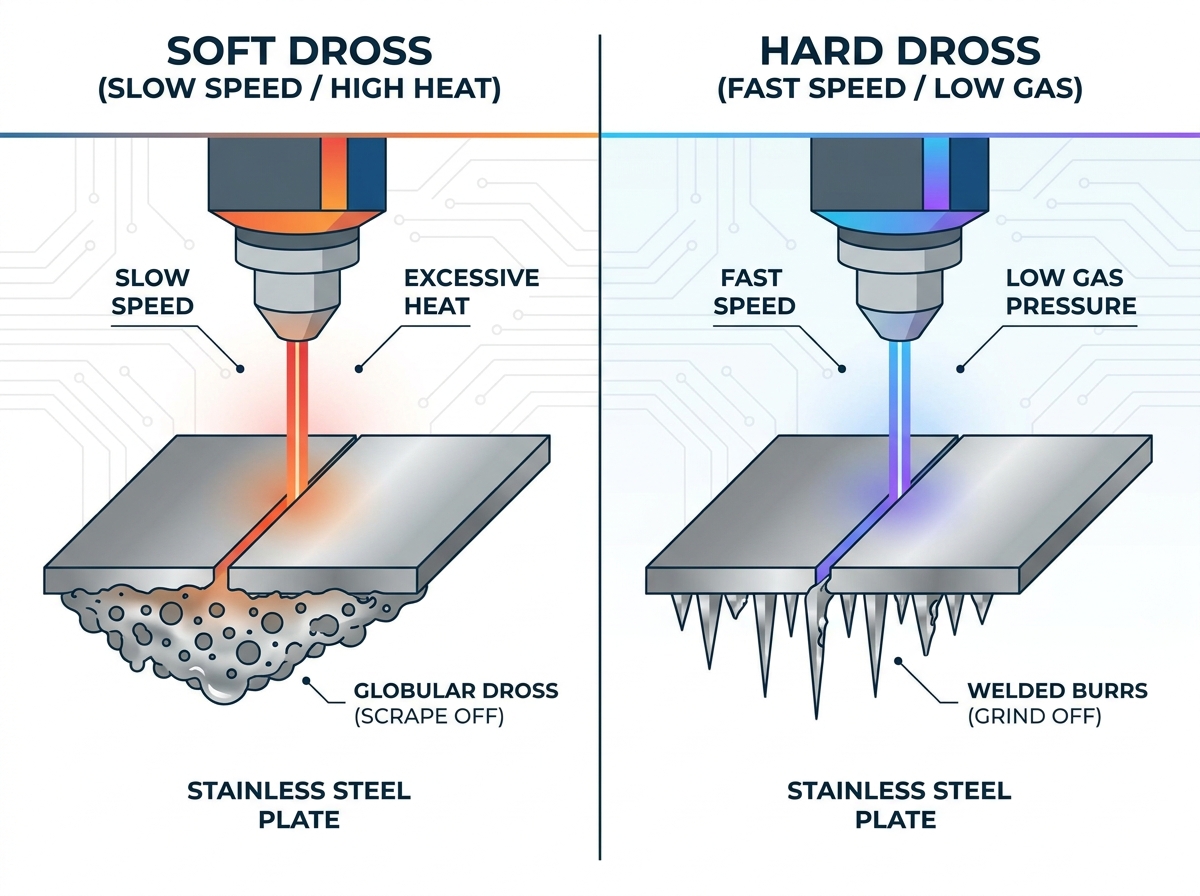
Diagnostic accuracy starts by examining the cut edge closely. You must differentiate between hard and soft accumulations. They point to entirely different parameter failures.
Soft dross feels porous and brittle. It forms thick, globular clusters along the bottom edge of the sheet. You can usually scrape it off easily. Sometimes a fingernail or a light wire brush removes it completely. The core cause revolves around excessive heat input. Your cutting speed is likely too slow. Slow feed rates over-melt the surrounding material volume. The gas cannot clear this massive volume of liquid metal fast enough. Additionally, your focal position might be set too high, concentrating heat unnecessarily near the surface.
Hard dross looks sharp and feels dangerous. It creates tightly welded beads resembling miniature stalactites. You cannot break these off by hand safely. They require aggressive mechanical grinding. Two core factors cause this specific defect. First, your cutting speed might be too fast. The molten metal simply lacks time to clear the kerf entirely. Second, assist gas pressure might be insufficient. Low pressure fails to blow the molten puddle downward with enough mechanical force.
Operators should use the physical properties of fiber laser cutting stainless steel dross as a primary indicator. Always analyze the defect visually before touching any machine settings.
Dross Type | Physical Characteristics | Primary Causes | Removal Difficulty |
|---|---|---|---|
Soft Dross | Porous, globular, brittle, thick clusters | Speed too slow, Focus too high (Excess Heat) | Easy (Fingernail or light wire brush) |
Hard Dross | Sharp, tightly welded stalactites, metallic | Speed too fast, Low gas pressure (Poor Ejection) | Difficult (Requires mechanical grinding) |
Several distinct variables dictate edge quality. These factors are the leading culprits behind persistent stainless steel laser cutting burrs.
Assist gas acts like a high-speed mechanical broom. Nitrogen physically ejects liquid metal downward through the kerf. If dynamic pressure drops, molten steel clings tenaciously to the bottom edge. Purity also dictates success heavily. Even 0.1% oxygen contamination ruins the entire cut profile. Oxygen triggers an immediate exothermic reaction. It changes the melt viscosity completely. These localized chemical reactions produce jagged edges and ugly oxidization marks. You must guarantee 99.99% nitrogen purity.
Incorrect focal positioning guarantees bad results. You must use a negative focus for stainless alloys. The focal point must sit inside or below the workpiece itself. For example, cutting an 8mm plate might require a -4mm focal position. Negative focus creates a wider kerf at the bottom of the cut. This specific geometry gives molten material a clear, expansive exit path. Focusing exactly at the surface creates a severe bottleneck underneath.
Hardware degradation disrupts everything quickly. A damaged nozzle alters gas flow dynamics instantly. Tiny spatters of slag can deform the copper orifice. Even a fraction of a millimeter of misalignment matters. It pushes assist gas against the kerf wall instead of straight down. This leaves severe burrs on one specific side of the cut part. Centering your beam is absolute priority number one.
You must strike a perfect balance between kW power and feed rate. Pushing speed too fast prevents complete penetration. It leaves distinct draglines angling backward. Draglines trap the melt and cause hard burrs. Conversely, moving too slowly overheats the localized cut zone. Excess heat melts too much volume. The assist gas simply cannot eject this expanded liquid puddle efficiently.
Follow this structured framework daily. Do not guess parameter values randomly. methodical troubleshooting saves hours of machine downtime.
Verify Nozzle Condition and Centering: Physical hardware always comes first. Inspect your consumables closely. Replace pitted or deformed nozzles immediately. Run a quick tape-shot test. Ensure perfect beam-to-nozzle concentricity. The hole in the tape must show a perfect, centered halo. Even microscopic deviations ruin cuts.
Calibrate Assist Gas Pressure: Check dynamic pressure carefully. You must read the pressure at the cutting head during active flow. Static line pressure tells an incomplete story. Pressure drops across long shop hoses frequently. Ensure your nitrogen supply lines avoid sharp bends or flow restrictions.
Adjust the Focal Point Deeply: Drop the focus deeper incrementally. Move in small 0.5mm steps. Run small test squares repeatedly. Evaluate the bottom edge after each test. Stop adjusting once the bottom edge clears entirely. Do not over-penetrate, as this widens the top kerf excessively.
Fine-Tune Speed and Power: Lock in your gas and focus first. Next, adjust your feed rate by 5-10% increments. Watch the spark trail under the sheet while cutting. Sparks should trail slightly straight down. They should resemble a tight shower. Severe upward spray indicates a major penetration failure. A severe backward lag indicates excessive speed.
Sometimes optimal parameters still yield bad edges. You must evaluate your foundational machine capabilities honestly. Recognize when you have hit a true hardware bottleneck.
Power (kW) vs. Thickness Constraints: A 2kW machine struggles immensely on 10mm plates. No amount of parameter tweaking fixes physics. It requires unsuitably slow speeds. Upgrading to 6kW, 12kW, or higher solves this completely. High power allows much faster speeds. It ensures cleaner melt ejection on thick sections.
Gas Delivery System Upgrades: Consistent dynamic pressure is mandatory for clean edges. Traditional cylinder nitrogen drops pressure too quickly during continuous runs. Assess your current setup. Consider upgrading to a bulk liquid nitrogen tank. High-pressure nitrogen generators also provide excellent stability and eliminate delivery delays.
Advanced Cutting Head Technology: Manual setup introduces heavy operator error continually. Consider the return on investment of advanced heads. Active beam-shaping technology changes the beam profile automatically for thick versus thin materials. Auto-focusing heads adjust instantly between jobs. These upgrades eliminate manual setup errors and deliver massive productivity gains.
Dross is never an inevitable byproduct of metal fabrication. It acts as a clear symptom of misaligned thermal and kinetic energy. Taking control of your parameter settings transforms your output quality permanently. Apply these concrete steps to improve your operations today:
Systematize your daily testing based entirely on physical dross properties.
Treat hard dross as a speed or gas issue, and treat soft dross as a heat issue.
Always verify your consumable health and beam centering before altering software parameters.
Perform a strict cost-benefit analysis if parameters hit a wall. Compare hardware upgrade costs against your ongoing labor waste.
Proactive edge quality management eliminates secondary grinding. Proper methodology protects your bottom line, reduces operator fatigue, and ensures perfect compliance with tight industry tolerances.
A: This is almost exclusively caused by poor beam centering within the nozzle. Alternatively, a damaged nozzle tip disrupts the assist gas flow on one specific vector. The gas pushes against the side wall instead of blowing downward. Always verify concentricity with a tape test and replace worn consumables.
A: It varies by material thickness and nozzle size. However, it typically ranges from 10 to 20 bar (145 to 290 psi) of dynamic pressure at the cutting head. Thicker materials inherently require higher pressure and larger nozzles to evacuate the heavier molten puddle.
A: Yes. Insufficient power for a given thickness requires unsuitably slow cutting speeds. This increases heat input drastically, causing soft dross and wider kerfs. Adequate power allows for a rapid, clean melt and immediate material ejection.
A: While possible, using oxygen creates an exothermic reaction. It leaves a heavily oxidized, blackened, and rough edge. If the part requires welding or aesthetic finishing later, you must mechanically remove this oxide layer entirely. Nitrogen remains the industry standard for clean cuts.
