 English

Views: 0 Author: Site Editor Publish Time: 2026-11-05 Origin: Site


Unplanned production downtime carries a hidden, severe risk. The immediate threat goes far beyond lost throughput or delayed shipments. It directly threatens traceability data integrity the moment your line restarts. Power cycles, emergency stops, and shift changes disrupt continuous operations daily. They cause legacy or poorly integrated marking systems to lose their exact sequence state. This operational fallout creates massive compliance failures and product recall risks. You face skipped IDs causing inventory mismatches and critical audit red flags. Manufacturers must move entirely beyond basic incremental software counters. You need robust, automated safeguards to protect your serialization data. This article provides a comprehensive technical framework for evaluating hardware and software safeguards. You will learn how to implement protocols ensuring absolute sequence integrity, regardless of unexpected line interruptions.
State Retention is Critical: Preventing sequence loss requires laser controllers with non-volatile memory or persistent state tracking that survives power loss.
Handshake Protocols Prevent Misfires: Relying on simple trigger sensors is insufficient; robust PLC-to-laser communication (request-to-mark, mark-in-progress, mark-complete) is required to prevent duplicates.
Single Source of Truth: Integrating fiber laser marking equipment directly with an MES or ERP system ensures serial numbers are allocated dynamically and verified in real-time, removing local counter risks.
Closed-Loop Verification: Pairing laser marking with inline vision systems (mark-and-read) provides the ultimate failsafe against unreadable, skipped, or duplicated direct part marks (DPM).
Direct part marking requires absolute precision across every production cycle. Every manufactured component must receive a unique, permanent identifier before moving to the next assembly phase. Production environments remain inherently unpredictable despite rigorous maintenance schedules. Interruptions happen daily due to mechanical jams, pneumatic faults, or operator interventions. You must understand exactly how these sudden stops corrupt serialization data at the hardware level.
The "buffer wipe" scenario represents a primary failure mode in manufacturing. A part enters the marking station and secures into position via pneumatic clamps. The laser begins engraving the serial number into the substrate. Suddenly, an operator hits the emergency stop button because a downstream conveyor jammed. Safety relays instantly drop the 24V DC power across the entire marking cell to comply with Category 3 safety standards. The local laser controller loses its volatile memory immediately. It forgets whether the current mark was completed successfully. When the operator clears the fault and restarts the system, the controller boots up blank. It resets its internal counter to the last hard-saved state on its flash drive. The laser then marks the exact same part with a new number, or it skips the current number entirely and moves forward. Both outcomes destroy sequence integrity.
The "double trigger" scenario presents another highly common sequence risk. A production line halts temporarily due to a downstream packaging bottleneck. A machined casting rests directly under the optical trigger sensor. The downstream bottleneck clears, and the line restarts abruptly. Heavy forklifts driving nearby or the sudden engagement of a large stamping press causes the floor to vibrate. This vibration makes the physical sensor beam flicker against the edge of the stationary casting. The sensor detects the part a second time and sends a brand new 24V high signal to the PLC. The laser fires immediately on an already-marked part. The internal software counter increments improperly. You now have a ruined component and a corrupted numerical sequence. Simple optical sensor setups cannot distinguish between new parts arriving and stationary parts vibrating.
Traceability errors carry massive regulatory scrutiny and operational headaches. Highly regulated sectors face strict compliance mandates regarding component identification. Medical device manufacturers rely heavily on Unique Device Identification (UDI) numbers mandated by the FDA under 21 CFR Part 801. A duplicate UDI compromises the entire device history record. If an auditor discovers a duplicate, it triggers immediate corrective and preventive action investigations. You must quarantine the entire production lot and trace the exact location of the overlapping serial numbers. If a duplicate shipped to a hospital, you initiate a mandatory product recall.
Aerospace and automotive manufacturers track traceability lots and production dates rigorously to comply with AS9100 and IATF 16949 standards. A single duplicated serial number invalidates the entire production batch. You lose the crucial ability to isolate specific defective components during a failure investigation. Labor hours skyrocket rapidly when sequence errors occur on the floor. Quality control teams spend weeks reviewing paper logs and database entries. Operators perform tedious manual rework to grind off overlapping marks. Inventory managers spend hours reconciling skipped numbers in central databases. Automated sequence protection remains the only viable strategy to prevent these administrative nightmares.
Hardware selection dictates your ultimate traceability success or failure. Not all laser systems handle sudden production interruptions equally well. You must evaluate the underlying architecture of the marking system carefully. Hardware capabilities directly influence your ability to recover from unexpected downtime without manual data entry.
Standalone systems operate as isolated islands of information. They rely entirely on internal software counters and operate independently from the main factory data network. Operators manually input the starting serial number at the beginning of the shift. The local software increments the number after each physical sensor trigger. This isolated approach carries a massive risk of sequence loss. Reboots, power failures, or software crashes reset the internal counter instantly. Operators must manually intervene to correct the sequence after a restart, frequently leading to duplicated blocks of serial numbers.
Networked systems offer superior reliability and automated error prevention. They act strictly as network clients, pulling serialization data directly from a centralized factory database. The laser controller requests the next specific number from the Manufacturing Execution System (MES) via REST API or SQL query. This architecture eliminates local memory reliance entirely. The centralized database acts as the definitive single source of truth. A power failure at the laser station does not corrupt the sequence because the MES retains the exact state of the production run securely. Networked systems recover flawlessly once power is restored to the cell.
Industrial laser controllers require robust memory architecture to survive power drops. Non-volatile RAM (NVRAM) and battery-backed SRAM are absolute non-negotiable requirements for local state retention. These specialized components retain critical data without continuous electrical power from the main supply. The controller caches the exact state of the active marking job constantly. It records the current serial number, the part position, and the handshake status in milliseconds during the marking cycle.
Power restoration triggers an automated recovery protocol within the controller. The controller reads the cached state directly from the NVRAM module. It resumes the numerical sequence exactly where it stopped previously. Volatile memory architectures cannot perform this critical recovery function. They wipe the data buffer clean during any significant power loss. Upgrading to controllers featuring persistent state tracking eliminates manual sequence resets and forms the foundation of automated sequence protection.
Your marking hardware must interact reliably with specific industrial substrates. Bare metals, anodized surfaces, and rigid plastics require vastly different laser parameters. High-speed production demands consistent mark quality across thousands of cycles. Poor material interaction causes low-contrast marks, shallow engravings, or excessive slag buildup. Vision systems cannot read low-contrast barcodes or faded alphanumeric strings accurately. Readability failures compromise your entire automated traceability workflow.
This readability failure triggers unnecessary and complex rework loops. The PLC rejects the part based on the vision system failure. The system attempts to remark the component to salvage it, which serves as a primary catalyst for sequence duplication errors. You must select robust fiber laser marking equipment to ensure high-contrast marks on difficult substrates like cast iron or highly reflective aluminum. Consistent mark quality keeps the production line moving smoothly. It prevents the vision system from initiating complex rework protocols and eliminates the root cause of many sequence disruptions.
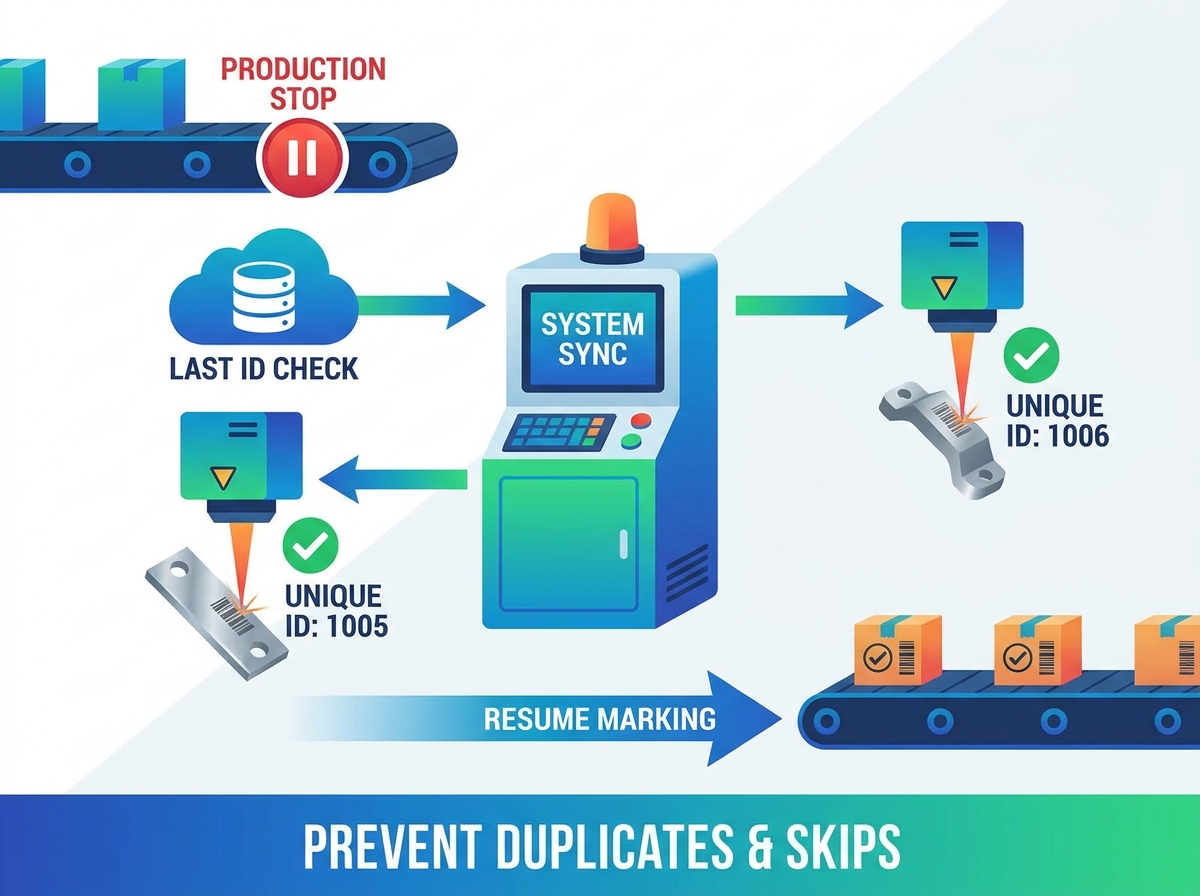
Zero-defect traceability requires precise integration features and strict communication rules. You must map specific hardware capabilities directly to your production workflow. Implementing these technical safeguards ensures absolute data integrity during unexpected events.
Simple trigger sensors fail consistently during line interruptions. You need robust PLC-to-laser communication to guarantee sequence integrity. The logic sequence governing the marking cell must be absolute. The PLC moves the physical part into the marking position and fires the pneumatic clamps. It sends a definitive "Request to Mark" digital signal to the laser via standard I/O blocks. The laser responds immediately with a "Ready" signal. The PLC then sends a "Start Mark" command. The laser drops the "Ready" signal and raises a "Mark in Progress" signal. The PLC holds the part firmly in place during this phase. It will not release the clamps until it receives a definitive "Mark Complete" signal.
Fault states require strict handling rules within the PLC ladder logic. A laser might fault mid-mark due to a hardware temperature error or a broken fiber cable. The PLC must recognize the missing "Mark Complete" signal instantly when the timeout window expires. It must route the partially marked part to a locked reject bin. The MES must flag the specific serial number as destroyed and never reuse that specific number in future cycles. Implementing these strict handshake protocols eliminates the risk of laser serial number marking duplicates during unexpected line stoppages. Proper handshake logic forces the system to acknowledge every single physical action.
Comparison of Trigger Methods for Laser Marking
Feature | Basic Sensor Triggering | Closed-Loop PLC Handshake |
|---|---|---|
Trigger Mechanism | Physical optical or proximity sensor | Digital logic signals via PLC I/O |
State Awareness | None. Cannot detect line stops. | Full. Tracks part position and clamp status. |
Duplicate Prevention | Low. Prone to double-triggering from vibration. | High. Requires strict "Mark Complete" confirmation. |
Fault Handling | Manual operator intervention required | Automated routing to locked reject bins |
Data Synchronization | Isolated local counter | Real-time MES database verification |
Dynamic data fetching modernizes the entire industrial marking process. The laser controller communicates directly with the MES via Ethernet protocols like PROFINET or Modbus TCP. It requests the next available serial number milliseconds before firing. This architecture handles complex JSON or XML data payloads effortlessly. Direct integration removes the need for operators to load daily batch files from USB drives. It ensures the laser always possesses the most current production data directly from the engineering department.
Modern systems map dynamic database fields in real-time during production. They generate incremental numbers, random alphanumeric strings, and specific part numbers simultaneously. They encode this complex data into 2D matrix or QR codes. The laser executes all these elements in a single marking pass. The "commit" phase remains critical for maintaining sequence integrity. The system only marks the ID as "consumed" in the database after physical confirmation from the PLC. A machine jam before the marking station does not waste a serial number. The database retains the unassigned number for the next successful cycle.
Inline barcode readers provide the ultimate failsafe for traceability operations. Machine vision cameras sit immediately following the laser marking station, often mounted inside the same safety enclosure. They execute a continuous validation loop on every single manufactured component. This automated inspection replaces unreliable manual quality control checks and prevents defective parts from reaching the shipping dock.
The camera reads the newly engraved serial number instantly. It checks the decoded string against the database to identify duplicates. It verifies the physical mark quality against strict industry grading standards like ISO/IEC 29158 (AIM DPM). The camera evaluates cell contrast, modulation, and fixed pattern damage. If the mark grades a 'D' or 'F', the camera signals the PLC to reject the part. This closed-loop system catches errors before parts leave the marking station. It prevents defective or duplicated marks from entering downstream assembly processes.
Deploying these advanced safeguards presents practical engineering challenges. Factory floors contain a complex mix of legacy and modern equipment. You must assess your current architecture carefully before purchasing new hardware. Proper planning prevents costly integration delays and unexpected compatibility issues.
Evaluate your current infrastructure thoroughly before purchasing new laser systems. Use this technical checklist to identify potential integration bottlenecks early:
PLC Age and Processing Speed: Legacy PLCs may lack the processing power or memory for complex handshake logic and string manipulation.
Network Latency: High latency delays database requests and stalls the high-speed production line.
Database API Availability: Your MES must support real-time data fetching via standard REST or SOAP protocols.
Physical Space Constraints: Ensure adequate room for inline vision cameras, specialized dome lighting, and secure reject bins.
Protocol Compatibility: Verify support for PROFINET, Ethernet/IP, or Modbus TCP across all devices.
Retrofitting advanced marking equipment onto legacy lines carries inherent risks. Basic relay logic cannot support closed-loop verification or dynamic data fetching. You may need to upgrade your primary line controllers to achieve zero-defect traceability. Attempting to force modern lasers onto outdated PLCs creates unstable production environments and constant communication timeouts.
Network latency destroys high-speed marking operations very quickly. The laser must wait for the MES to allocate a new number. If the server response takes 200 milliseconds due to cloud hosting delays, the entire line stalls. Edge-computing provides a highly reliable mitigation strategy for latency issues. Install an industrial PC (IPC) running a local database instance directly on the line. This localized buffer server caches a block of serial numbers near the laser station. The laser pulls from the local buffer instantly with 1-millisecond latency. The buffer server syncs with the central MES securely in the background.
Human intervention causes most sequence errors on the factory floor. Maintenance technicians often bypass handshake logic during routine troubleshooting. They force PLC inputs high to clear jams or test mechanical actuators. This breaks the critical synchronization between the physical parts and the database. You must lock down manual override capabilities within the PLC program. Require engineering-level credentials to bypass the automated PLC handshake. Train operators extensively on the severe consequences of sequence disruption.
Advanced serialization systems require strategic planning and careful evaluation. You must weigh the operational benefits against your long-term production goals. Understanding these value factors helps justify the necessary engineering upgrades without relying on basic hardware comparisons.
Advanced PLC integration and vision systems represent a significant engineering upgrade. You must compare this capability against the devastating impact of compliance failures. A single product recall halts production entirely and triggers massive regulatory audits. Regulatory audit failures damage brand reputation permanently in highly competitive markets. Customers demand absolute traceability from their manufacturing partners and will shift contracts to competitors who can guarantee data integrity.
Robust sequence integrity eliminates these massive regulatory risks. You secure your traceability data against unexpected downtime and operator errors. The system prevents unreadable or duplicated marks from entering the global supply chain. This massive risk reduction justifies the integration of closed-loop verification hardware. Protecting your data integrity protects your entire manufacturing operation from catastrophic compliance breaches.
Centralized serial number management scales effortlessly as your facility grows. High-volume facilities operate multiple laser marking stations simultaneously across different buildings. Centralized databases prevent two different lines from pulling the exact same sequence block. This centralized control remains vital for global manufacturing operations where multiple plants produce the same component family.
Consistency and speed remain paramount in high-volume production environments. Complex marks include brand names, manufacturing dates, and dense QR codes. Advanced controllers process these complex marking files instantly. They apply the marks without bottlenecking throughput or slowing the conveyor. Scalable architecture allows you to add new marking stations seamlessly. You can expand capacity without reconfiguring your entire traceability network or rewriting core PLC logic.
Preventing duplicate and skipped serial numbers requires a structural engineering approach. Buying a faster laser does not solve underlying sequence corruption issues. You must implement robust state-retention hardware and strict communication protocols. Sequence integrity relies entirely on how your equipment handles unexpected interruptions and power drops.
Prioritize vendors who offer native MES integration and robust API support. Demand transparent PLC handshake documentation during the initial procurement process. Built-in vision verification options provide essential automated quality control. Focus entirely on data integration capabilities and state-retention features rather than raw marking speed.
Take these immediate next steps to secure your traceability data:
Conduct a comprehensive traceability audit on your current production line to identify manual data entry points.
Map the exact sequence of events and data flows during an emergency stop to find memory vulnerabilities.
Request proof-of-concept demonstrations from laser integrators focusing specifically on database recovery after a power loss.
Upgrade legacy PLCs to support closed-loop handshake protocols and Ethernet communication.
Implement edge-computing buffers if your facility suffers from high network latency or frequent connection drops.
A: Duplicate serial numbers typically result from local counter resets during power failures. They also occur when physical sensors double-trigger during line restarts due to vibration. A lack of strict PLC handshake protocols allows the laser to fire without verifying if the part was already marked.
A: A power failure wipes the volatile memory of standard laser controllers. The system loses its current count and sequence state. This requires manual operator intervention to reset the sequence unless the controller uses non-volatile memory or direct database integration for auto-recovery.
A: Yes. Modern industrial fiber lasers support standard industrial protocols like TCP/IP, Ethernet/IP, or PROFINET. These protocols allow the laser controller to pull serialization data directly from ERP or MES databases in real-time, eliminating local data storage.
A: Advanced marking software maps dynamic database fields to multiple mark objects. It links the database payload to both human-readable text and 2D codes within a single marking file. This ensures all elements stay perfectly synchronized, even after a line stop.
A: A mark-and-read system integrates a laser marker with an inline machine vision camera. The camera immediately scans the newly applied mark to verify the serial number's readability, uniqueness, and quality grade before the part moves down the line.
A: You recover skipped numbers through strict database reconciliation processes. The system flags the specific number as void or destroyed in the MES. You should never attempt to manually re-insert a skipped number into the physical production flow.
