 English

Views: 0 Author: Site Editor Publish Time: 2026-10-28 Origin: Site


Repairing or manufacturing micro-link, box, snake, and rope chains presents a significant thermal management challenge. Jewelers face constant frustration when fixing pieces measuring under a millimeter in thickness. Traditional soldering often results in stiff joints, flooded links, or complete material melt. You risk destroying delicate customer heirlooms, leading to unbillable rework and damaged trust.
Upgrading to a specialized jewelry laser welder for chain repair transitions the process from ambient heating to highly localized, rapid energy delivery. Instead of blasting an entire section with a torch, you apply a microscopic burst of targeted heat. This precision keeps adjacent links completely cool and flexible.
Successfully laser welding thin jewelry chains without causing blowouts or brittle joints requires moving beyond base power settings. You must master two critical variables: millisecond pulse shaping and precise mechanical workholding. This guide breaks down the physics of energy delivery, proper fixturing techniques, and equipment selection to guarantee flawless chain restoration.
Pulse Control Over Raw Power: Successful chain repair relies on managing peak power and pulse duration to overcome the high reflectivity of gold and silver without vaporizing thin wire gauges.
Workholding Dictates Yield: Sub-millimeter laser accuracy is useless if micro-links shift during the weld pool formation; proper tensioning and fixturing are non-negotiable.
Equipment Evaluation Criteria: The ROI of a laser welder is determined by its minimum spot size capability, microscope optics clarity, and integrated shielding gas delivery, not just maximum Joule output.
High scrap rates heavily burden modern repair shops. Traditional torch soldering on fine chains—especially those under a 1mm gauge—creates an unacceptable margin of error. Ambient heat floods solder into surrounding mechanical junctions. It freezes the chain, creating rigid, unnatural sections. You spend hours filing and polishing, which eats directly into your profit margins.
Precious metals exhibit unique thermal behaviors. Silver and high-karat gold reflect laser energy effectively at room temperature. The metal acts like a mirror, bouncing the initial beam away. However, once the targeted spot reaches its melting point, surface reflectivity drops to zero. Energy absorption spikes instantaneously. If you apply too much raw power, this sudden spike causes instant vaporization. Thin links literally disappear, leaving a gaping hole instead of a clean joint.
We define success in micro-link repair by three strict criteria. First, you must achieve a structurally sound weld. Second, the joint must remain completely flexible. Third, the process should require zero post-weld filing or polishing. The repaired segment must maintain the original tensile strength of the chain. Reaching this standard requires abandoning traditional techniques and adopting precise photon manipulation.
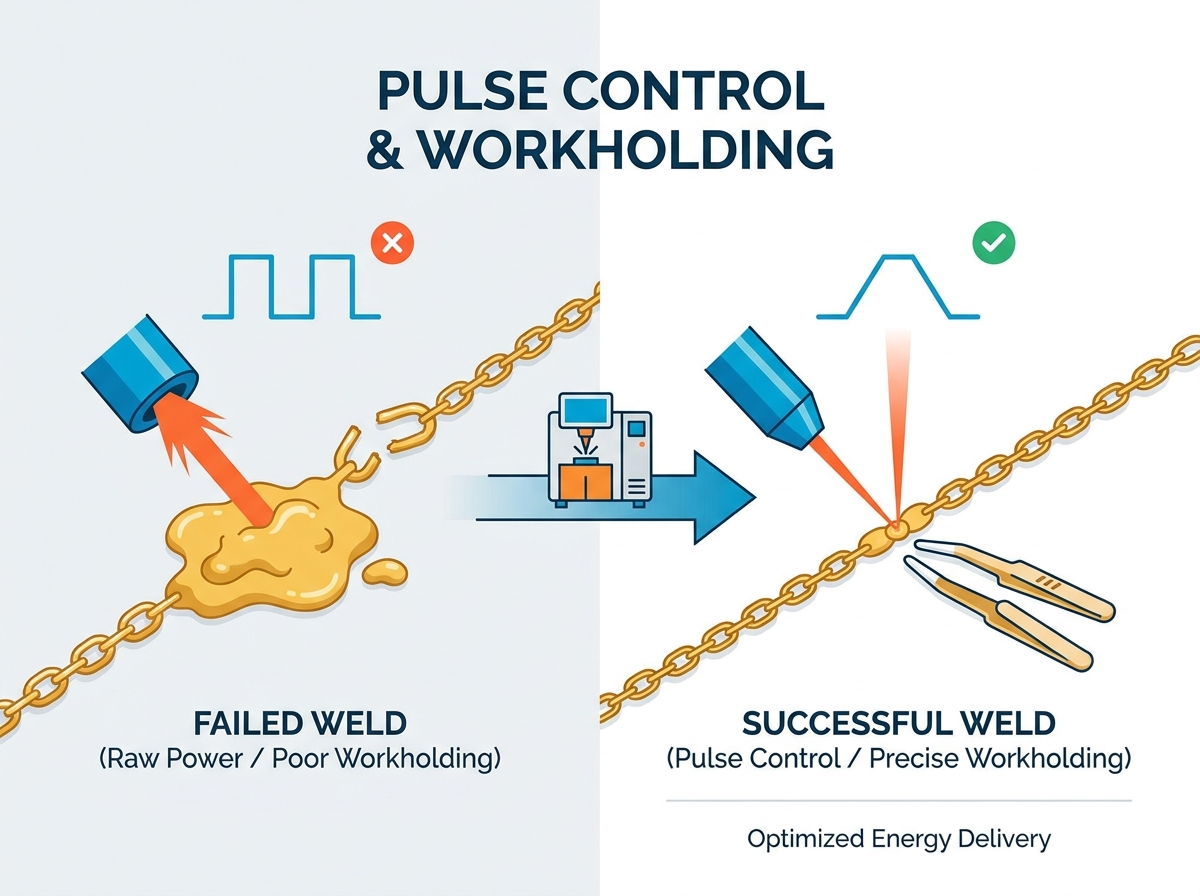
Controlling the exact shape of your laser burst prevents metal destruction. Standard square-wave pulses turn the laser on at full power and off instantly. This abrupt delivery shocks fine chains. It causes micro-cracking upon rapid cooling. Advanced equipment provides ramp-up and ramp-down pulse shaping. The beam gently pre-heats the metal, melts it, and slowly cools the weld pool. This curve reduces thermal shock significantly.
When mastering pulse laser welding gold chains, you must balance three primary parameters. You need adequate peak voltage to overcome initial surface reflectivity. However, high power demands strict time limits. You must keep the pulse width exceptionally short—typically between 0.5 to 1.5 milliseconds. Short bursts prevent heat from propagating down the wire. Frequency dictates how many pulses fire per second. For manual manipulation, lower frequencies like 1-2 Hz work best. This rhythm allows operator repositioning between shots.
Beam spot size acts as your final control mechanism. You must focus the beam down to 0.1mm or 0.2mm. Striking a larger area melts adjacent, unintended metal. Hitting just the single junction ensures the chain retains natural movement. Operators must verify their focal length before ever pressing the foot pedal.
Material Type | Peak Power Level | Pulse Width (ms) | Pulse Shape / Waveform | Shielding Gas Need |
|---|---|---|---|---|
14k Yellow Gold (< 0.5mm) | Medium | 0.5 - 0.8 | Standard Ramp-Down | Moderate |
Sterling Silver (< 0.5mm) | High | 0.5 - 1.0 | Aggressive Spike + Ramp-Down | Critical (High Argon) |
Platinum Chains | Low-Medium | 1.0 - 1.5 | Square Wave / Flat | Low |
Sub-millimeter laser accuracy holds no value if your material moves. The most common mistake operators make involves resting chains on a flat surface. When metal transitions from liquid to solid, it shrinks. Without slight, controlled tension, this weld pool shrinkage pulls the links together. The chain will inevitably kink. You must apply gentle outward pressure during the weld.
Jewelers use several distinct fixturing approaches to maintain this crucial tension. Handheld stability requires specific tools. Non-reflective materials keep stray laser beams from bouncing into your eyes or damaging the equipment.
Precision Ceramic Tweezers: Ceramic does not conduct heat. It prevents the operator from burning their fingers during rapid, repetitive welding. It also absorbs stray laser flashes safely.
Titanium Tweezers: Titanium offers excellent heat resistance. It provides a firmer grip on slippery metal than ceramic, making it ideal for heavier rope chains.
Micro-Vises and Alligator Clips: These tools secure the anchor points on your bench. They free up both of the operator's hands. You can then use one hand to position the chain and the other to feed a 0.1mm filler wire if necessary.
Custom Copper Jigs: Ultra-thin chains overheat quickly. Copper acts as an aggressive heat sink. Placing the chain across a small copper block draws excess thermal energy away from the immediate weld zone, preventing blowout.
You must practice aligning the microscopic gaps. If a gap exceeds the thickness of the wire, you cannot bridge it using only the base metal. You must compress the links flush before firing the laser.
Procuring hardware demands a careful review of specific technical capabilities. Raw power output rarely dictates success in fine jewelry repair. You should evaluate machines based on their finesse. Optical clarity stands as the absolute priority. If you cannot clearly see a 0.1mm gap through the microscope, you cannot weld it. Look for systems utilizing high-tier Leica stereo microscopes. The crosshairs must perfectly match the actual beam strike location to avoid parallax errors.
Argon gas integration heavily influences post-weld workflow. Ensure the machine delivers shielding gas coaxially. Coaxial delivery flows gas straight down the same path as the laser beam. This localized blanket displaces oxygen. It prevents dark oxidation and soot from forming on silver and white gold. Clean welds require zero post-process filing, saving massive amounts of bench time.
Cooling system architecture dictates continuous operation times. Industrial manufacturing requires robust internal water-to-water cooling. However, intermittent repair shops often operate perfectly well with smaller, internal water-to-air radiators. Assess your daily volume before over-specifying a cooling system.
You must also factor in implementation realities. Consider the footprint required in your retail shop. Assess standard consumable replacements. Flashlamps degrade over time and require swapping. Deionized (DI) water filters need periodic replacement to keep the cooling loop clean. Protective lens shields take the brunt of microscopic spatter and must be kept pristine for optimal optical clarity.
Capital expenditure for quality optical equipment ranges between $5,000 and $25,000. You justify this expense entirely through increased throughput. Jobs previously labeled "unrepairable" become highly profitable five-minute tasks. Traditional torch soldering requires flux, pickling, heating, and aggressive polishing. Laser systems eliminate these steps. You balance the initial equipment cost against the direct conversion of repair hours into minutes.
Do not underestimate the operator training curve. Hardware alone guarantees nothing. Operators require dedicated bench time. They must build deep muscle memory for foot-pedal timing. They must develop microscopic spatial awareness. Moving items under a 10x magnification lens feels disorienting initially. You should expect a two-week learning curve before an operator achieves commercial speed on difficult pieces.
You should follow a strict testing protocol before committing to a purchase. Never buy a machine based on a brochure. Request live sample welds. Send the vendor your most problematic chain styles. Hollow rope chains and micro-snake chains serve as excellent benchmarks. If a machine handles a 0.5mm hollow gold rope chain without blowout, it will easily handle standard bench repairs. Let actual material performance dictate your final decision.
Mastering pulse dynamics and tension control changes the fundamental nature of your repair business. Sourcing the right equipment transforms micro-link chain repair from a high-risk liability into a predictable, high-margin service.
Prioritize granular waveform control over maximum wattage.
Invest in high-tier stereo optics to guarantee visual accuracy.
Adopt rigid workholding habits and use copper heat sinks for delicate jobs.
Test difficult hollow chains during vendor demonstrations before buying.
Ensure coaxial argon delivery to eliminate post-weld cleanup time.
Let your specific daily operational requirements dictate your final capital investment. Focus entirely on precision, operator comfort, and verifiable throughput improvements.
A: No. Silver is highly reflective and highly thermally conductive. It demands a higher initial peak power to penetrate the surface. However, it requires a much shorter pulse width compared to welding gold. If the pulse stays on too long, the silver vaporizes. High-flow argon gas is also absolutely critical to prevent severe blackening and soot buildup on silver.
A: Often, no. If you manipulate the links so they sit perfectly flush, you can perform an autogenous weld. This means you simply fuse the existing metal together. Adding filler wire to a sub-millimeter link adds unnecessary bulk. It ruins the natural flex of the chain and forces you to file the joint afterward.
A: For extremely fine chains, evaluate machines capable of dialing the spot size down to 0.1mm or 0.15mm. Precision is everything. Larger spot sizes, such as 0.5mm, will inadvertently strike adjacent links. This melts unintended areas together, freezing the chain's mechanical movement and ruining the repair.
