 English

Views: 0 Author: Site Editor Publish Time: 2026-10-30 Origin: Site


Industrial paint stripping carries massive stakes for modern manufacturers and restoration experts. Removing robust industrial coatings without altering the dimensional tolerances of the underlying steel represents a daily challenge. Facilities must also protect the specific metallurgical properties of their critical components. Traditional abrasive methods frequently fail at this task. Aggressive media causes micro-pitting and induces severe mechanical stress on delicate metal surfaces.
While advanced optical technology offers a powerful non-contact alternative, it demands absolute precision. Selecting the wrong type of equipment or applying incorrect operating parameters will permanently deform steel parts. This turns high-value industrial assets into worthless scrap metal.
This comprehensive guide provides a technical framework for modern engineers and buyers. You will learn to evaluate and implement these highly advanced optical systems safely. We explore the physics of photothermal ablation and highlight the exact metrics needed to protect your base metals. Mastering these principles ensures you execute successful stripping operations while maintaining total component integrity.
Ablation vs. Melting: Pulsed lasers rely on photothermal ablation, stripping paint layer-by-layer without transferring sustained heat into the steel substrate.
Parameter Control is Critical: Avoiding substrate damage requires precise tuning of pulse duration, frequency, and scanning speed.
Equipment Selection: Continuous Wave (CW) lasers are cheaper but highly prone to warping steel; pulsed systems are the mandatory choice for precision component recovery.
Implementation Reality: Successful deployment requires proper focal distance management and integrated fume extraction to maintain operator safety and consistent results.
Heavy industry often defaults to traditional media blasting for surface preparation. Sandblasting and aggressive abrasive media physically tear away microscopic layers of steel alongside the paint. This destructive action ruins tightly toleranced mating surfaces in the process. Engineered components lose their precise mechanical dimensions. Bearings fail to seat properly. Engine blocks lose crucial compression seals. The physical impact simply removes too much original material.
Thermal distortion presents another severe mechanical issue. Traditional heat-stripping methods push intense thermal energy deep into the metal structure. Thin-gauge steel components warp rapidly under this excessive thermal load. Automotive body panels buckle and deform. Aerospace skins lose their aerodynamic profiles. Operators struggle constantly to maintain the original geometric shape of the part. Once thin steel warps, repairing it becomes nearly impossible.
Chemical degradation poses serious operational and environmental risks. Caustic chemical solvents generate massive volumes of hazardous waste. They force facilities to navigate costly environmental compliance hurdles and strict disposal regulations. Furthermore, chemical solvents introduce hydrogen embrittlement risks in high-strength steel alloys. The chemicals seep into microscopic grain boundaries, weakening the structural integrity of the steel. Disposal bottlenecks eventually slow down entire production pipelines.
Frame the switch to advanced optical methods as a mandatory risk-mitigation strategy. Relying on outdated methods jeopardizes high-value steel parts. Implementing pulsed laser paint removal protects your crucial operational timelines. It ensures every component passes strict quality assurance inspections. You protect the physical asset while eliminating hazardous environmental variables.
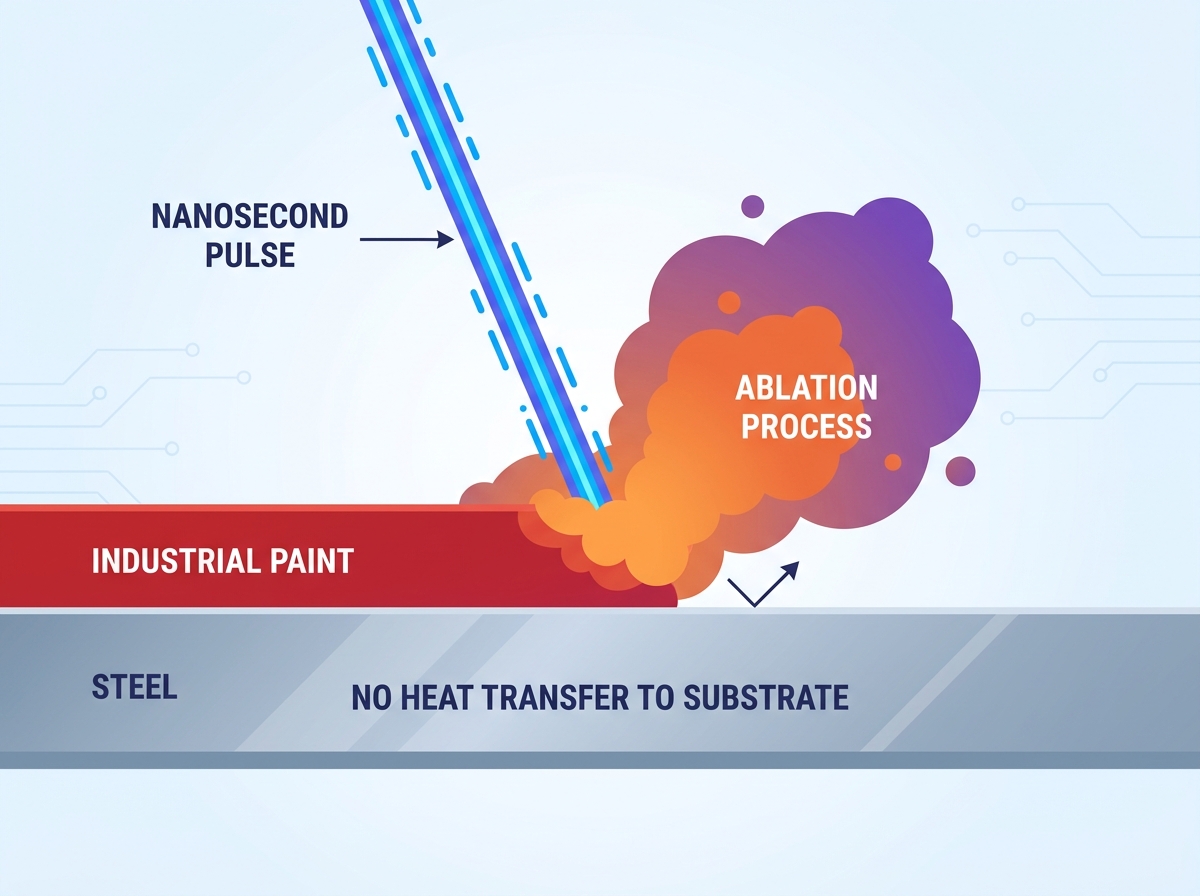
The core physics of the ablation threshold drive this entire technology. Industrial coatings like epoxy, polyurethane, and heavy rust share one vital characteristic. They possess a significantly lower ablation threshold than the raw steel substrate beneath them. This energy gap allows optical tools to target the coating selectively. The system exploits this threshold difference to vaporize the paint completely.
Advanced optical generators deliver extreme peak power in nanosecond bursts. The top layer of paint absorbs this immense energy instantly. The coating undergoes rapid thermal expansion and vaporizes into a plasma plume. Because the energy pulse lasts mere nanoseconds, the thermal energy cannot conduct deeply into the steel mass. The underlying metal stays remarkably cool throughout the entire process.
The reflection principle adds an essential, built-in safety net. Solid bare steel naturally reflects the specific 1064nm wavelength emitted by fiber lasers. Once the paint disappears, the exposed metal deflects the incoming light beam. This creates an automatic stop mechanism. It effectively halts further material removal immediately. The tool cannot aggressively bite into the base metal the way a grinding wheel does.
What defines successful laser cleaning painted steel? You must look for specific physical indicators on the finished part.
Zero Micro-Melting: The surface must show absolutely no signs of localized liquid metal pooling.
Intact Original Surface Profile: Factory machining marks and original textures must remain completely undisturbed.
No Heat-Affected Zones (HAZ): The steel should never exhibit blue, yellow, or purple thermal discoloration.
Complete Coating Removal: Deep pores in the steel must be free of residual primer or epoxy.
Operators must respect the physical limits of optical equipment. You must dial in highly specific machine settings to prevent laser cleaning substrate damage. Understanding how these distinct variables interact guarantees a safe and highly repeatable stripping operation.
Pulse duration defines exactly how long the energy beam interacts with the surface. Shorter pulses typically last between 50 and 100 nanoseconds. They drastically minimize the internal Heat-Affected Zone (HAZ). These rapid energy bursts suit thin automotive steel perfectly. They also work incredibly well for delicate aerospace components. Shorter durations ensure the thermal wave never penetrates past the paint layer. Longer pulses invite unwanted thermal conductivity.
Pulse frequency dictates how many energy bursts hit the surface per second. High frequency creates a much smoother, blended cleaning pass. However, it significantly increases localized heat build-up. A very high repetition rate pumps residual thermal energy into the component. Operators must carefully balance this frequency against their physical scan speed. You avoid warping metal by matching your repetition rate directly to your hand speed.
Internal galvo mirrors sweep the light beam across the surface rapidly. Moving this beam too slowly invites immediate mechanical trouble. It leads directly to localized substrate melting. We recommend establishing strict baseline scanning velocities based on specific coating thickness. Thicker industrial paint requires multiple fast passes, not a single slow pass. Slowing down the scan speed acts as a common, yet destructive, operator mistake.
Many buyers incorrectly assume higher wattage equals superior cleaning power. This dangerous misconception frequently causes ruined parts. Overall machine wattage merely indicates average power output over time. Instead, energy per pulse dictates true performance. We measure this critical metric in millijoules (mJ). High mJ easily shatters heavy chemical bonds in industrial paint. It achieves this vaporization without harming the steel structure beneath. Always evaluate equipment based on single-pulse energy capability, not just top-end wattage.
Understanding the technological split in the optical market saves buyers from expensive mistakes. Two distinct machine categories dominate the industry. They behave completely differently upon contact with bare metal.
Equipment Comparison: CW Lasers vs. Pulsed Fiber Lasers
Feature Set | Continuous Wave (CW) Systems | Pulsed Fiber Systems |
|---|---|---|
Core Mechanism | Emits an uninterrupted energy beam | Delivers extremely high peak power in nanosecond bursts |
Average Heat Transfer | Extremely high continuous heat load | Very low internal heat load |
Substrate Damage Risk | High (causes severe warping and micro-cracking) | Minimal (when tuned correctly by operator) |
Primary Applications | Thick steel plates, brute-force rust stripping | Molds, aerospace parts, thin-gauge automotive panels |
Initial Investment Level | Lower capital expenditure requirement | Higher initial capital expenditure requirement |
Continuous Wave lasers emit an uninterrupted, constant beam of raw energy. They rely heavily on melting or burning the material off the surface. They do not utilize pure photothermal ablation. This creates an exceptionally high risk for precision metal. The underlying steel frequently suffers from localized warping. High continuous heat also triggers dangerous micro-cracking along stress lines. We consider CW systems suitable only for thick structural steel plates. They handle brute-force rust removal where precision remains entirely irrelevant to the final product.
Pulsed fiber generators operate on a vastly superior technical principle. They deliver immense peak power alongside incredibly low average heat transfer. Buyers do face a higher initial capital expenditure (CapEx) when sourcing these units. Furthermore, operators require dedicated training to dial in the correct parameters. However, the technical verdict remains completely clear. Pulsed systems act as an absolute requirement for critical tasks. They safely restore plastic injection molds. They strip vintage automotive panels perfectly. Preserving the underlying steel is always non-negotiable in these precise manufacturing applications.
Procuring advanced equipment solves only half the engineering equation. Successful facility deployment demands strict adherence to operational best practices. Ignoring these specific environmental variables compromises both the machine and the steel component.
Lenses focus the raw light beam at a highly specific distance. Holding the handheld unit outside this optimal focal length causes immediate operational problems. The beam widens, which dramatically reduces paint removal efficiency. When efficiency drops, operators naturally tend to slow down their hand movements. This natural reaction inadvertently causes rapid, destructive heat build-up on the metal. Maintaining the precise focal distance remains absolutely critical for thermal management.
Vaporized paint creates dangerous, highly toxic fumes. The ablation process also releases microscopic particulate matter directly into the surrounding air. Failing to use integrated, high-capacity fume extraction fouls the machine's protective lens. A dirty, contaminated lens degrades overall beam quality instantly. It scatters the focused light. This scattering causes highly inconsistent stripping results and dramatically raises internal lens temperatures.
Operator guesswork leads directly to scrapped parts. We strongly recommend establishing standardized numerical recipes for your team. Create strict preset parameters for different steel grades. Document specific frequency and duration settings for varying paint thicknesses. Tape these reference charts directly to the machine. Strict protocols remove human error and ensure repeatable, safe outcomes every single time.
Buyers must validate this sophisticated technology before committing facility capital. Follow a structured evaluation path to guarantee success:
Demand a custom proof-of-concept (PoC) demonstration from the manufacturer.
Send a scrap piece of your specifically painted steel to their application lab.
Request full documentation of the exact ablation thresholds used during the test.
Inspect the freshly cleaned sample under magnification for microscopic substrate damage.
Verify all original surface profiles remain physically unchanged before issuing a final purchase order.
Pulsed laser technology stands firmly as the premier method for stripping industrial steel. You must strictly respect the fundamental physics of photothermal ablation to succeed. Operators must control pulse duration, frequency, and scanning speed tightly. Investing in a highly precise pulsed system over a rudimentary CW alternative always pays off. It represents a direct, critical investment in absolute substrate safety.
Deploying this advanced equipment guarantees long-term quality assurance across your entire manufacturing floor. You eliminate mechanical deformation completely. You eradicate the environmental hazards associated with chemical solvents. Take decisive action today to protect your high-value steel components.
Schedule a detailed technical consultation with a dedicated optical equipment expert. Request a custom sample test utilizing your own coated materials. Validate this powerful, non-contact technology on your specific industrial applications.
A: No. Because the pulse duration is incredibly short, heat does not penetrate the substrate deeply enough to alter metallurgical properties. The original physical hardness remains perfectly intact, provided operators set the machine parameters correctly.
A: Yes. However, it requires multiple swift passes rather than one slow, high-heat pass. This strategic layered approach ensures the steel substrate remains completely cool during the entire stripping process.
A: Look closely for physical discoloration like bluing or yellowing on the bare metal. This indicates dangerous excess heat accumulation. Also, watch for a change in the surface profile, such as micro-melting. Proper parameter tuning leaves the steel looking exactly as it did before it was painted.
A: Yes, it is the safest stripping method available today. Unlike media blasting or continuous wave optical systems, optimized pulsed generators will not warp or permanently deform delicate automotive or aerospace steel panels.
