 English
Views: 0 Author: Site Editor Publish Time: 2026-03-23 Origin: Site
In the world of precision manufacturing, the CO2 laser machine remains a cornerstone technology. However, not all laser sources are created equal. For years, the industry relied on glass DC (Direct Current) tubes, which were affordable but fragile. Today, the shift toward Professional Industrial applications has highlighted a superior alternative: the Radio Frequency (RF) laser source.
What makes an RF laser source unique isn't just one single component; it is a symphony of advanced physics and engineering. From how the gas is excited to how the heat is managed, RF technology fundamentally changes the capabilities of a CNC CO2 laser machine. In this guide, we will break down the key technologies—such as Transverse Discharge, Slab Waveguides, and Dielectric Barriers—that provide the High precision and High power reliability required for modern production lines. By understanding these "Expert Insights," you can make a better-informed decision for your next equipment investment.
The most fundamental difference between a standard glass tube and a Professional RF source lies in the excitation method. Traditional systems use longitudinal DC discharge, where high voltage travels the length of the tube. In contrast, an RF-driven CO2 laser machine utilizes a transverse discharge.
In an RF system, the electrodes are placed outside or along the sides of the laser cavity, perpendicular to the optical axis. They apply a high-frequency alternating electric field (10–200 MHz). This excites the gas molecules without the electrodes ever touching the gas. Because there is no direct contact, it eliminates electrode erosion—the leading cause of gas contamination in cheaper glass tubes.
Transverse discharge ensures that energy is distributed evenly throughout the gain medium. This uniformity is what allows an Industrial CO2 laser machine to maintain a perfectly stable plasma. For the user, this translates to a consistent beam that doesn't flicker or lose power during long cutting jobs. It creates a reliable foundation for any High precision task, ensuring that the first cut of the day looks exactly like the last.
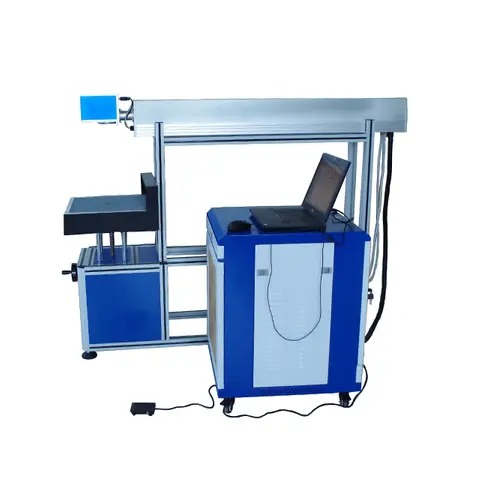
A major "Expert Insight" regarding RF technology is the use of the Dielectric Barrier Discharge (DBD). This innovation acts as a physical and chemical shield, preserving the internal environment of the laser source for thousands of hours.
In conventional DC lasers, the metal electrodes "sputter" over time, releasing tiny metallic particles into the gas mixture. These particles eventually coat the mirrors and degrade the beam quality. RF sources solve this by using a dielectric (insulating) layer between the electrode and the gas. It works like wireless charging; the energy passes through the barrier, but the physical material stays put.
Because the gas remains pure, the laser doesn't "age" nearly as fast as a glass tube. This is why a Professional CO2 laser machine equipped with an RF source can often run for 20,000 hours or more before needing a gas refill. For a business, this means fewer interruptions, lower maintenance costs, and a much higher return on investment compared to replacing glass tubes every few months.
To understand why RF lasers are so stable, we must look at their Voltage-Current (V–I) characteristics. This is a technical nuance that separates a hobbyist tool from a truly Industrial CO2 laser machine.
DC glass tubes have "negative resistance." If the current goes up, the voltage drops, which makes the current go up even faster. This is inherently unstable and requires bulky ballast resistors to keep the tube from exploding or the plasma from collapsing. RF plasma has a positive V–I characteristic. If the current rises, the voltage required to sustain it also rises. This creates a natural "braking" effect that keeps the plasma perfectly balanced.
By eliminating the need for energy-wasting ballast resistors, the RF source is inherently more efficient. It allows the CNC controller to have much finer control over the output. When you need a High precision engrave at 1% power, the RF source can deliver it consistently, whereas a DC tube might struggle to even ignite the gas at such low levels.
A waveguide is a structure that "guides" the laser light, and in RF technology, the electrodes themselves often double as the waveguide. This is a primary reason why an RF-powered CO2 laser machine has such superior beam quality.
In a wide glass tube, the light can bounce around and create "messy" patterns (higher-order modes). A slab waveguide confines the light between two very closely spaced parallel plates. This structure forces the laser to stay in its fundamental Gaussian mode ($TEM_{00}$). The result is a perfectly round, sharp spot.
Because the beam is confined and guided, it can be focused into a much smaller point. A smaller spot size means a higher energy density. Even at the same wattage, an RF CO2 laser machine can often cut faster and cleaner than a DC laser because its energy is more concentrated. This High precision is vital for intricate lace cutting, micro-fluidic chips, or high-detail portrait engraving.
The slab design also has a massive surface area. This allows heat to be pulled away from the gas very quickly. By keeping the gas cool, the system avoids "thermal lensing," where heat distorts the beam shape. This ensures that your Industrial laser stays accurate even when running at High power for a 24-hour shift.
Traditional lasers are limited by how fast they can turn on and off. RF sources use high-frequency modulation (Pulse Width Modulation or PWM) to achieve a level of control that digital printing would envy.
Because the RF field can be switched at radio frequencies, the laser's response is nearly instantaneous. There is no "warm-up" period for the gas to ionize. This allows the CO2 laser machine to perform complex grayscale engraving by rapidly changing the duty cycle of the pulses.
Engraving: Achieve exceptional detail with no "over-burn" at the start or end of a line.
Cutting: At higher duty cycles, the laser delivers a consistent stream of energy for smooth, flame-polished edges on acrylic.
Punching: The high-frequency pulses allow for "perforation" modes that are essential for breathable fabrics or filter materials.
This speed is what makes the RF source a Professional choice. It allows a CNC system to move at high velocities without the "dotted line" effect seen in slower laser sources.
Heat is the enemy of laser stability. If the cavity gets too hot, the beam's $M^2$ factor (a measure of beam quality) degrades, and the focus shifts. RF laser sources are engineered to be either Water cooled or highly efficient air-cooled systems.
Because the heat is managed so well, the beam doesn't "drift" as the machine warms up. In a long production run, a glass tube's focus might shift by several millimeters as the tube expands. An RF source remains stable, ensuring that the High precision you set at 8:00 AM is the same at 5:00 PM. This is non-negotiable for Industrial applications where parts must meet strict tolerances.
| Feature | DC Glass Tube | RF Metal/Ceramic Tube |
| Cooling | Water (Required) | Water cooled or Air |
| Thermal Drift | High | Very Low |
| Material | Borosilicate Glass | Aluminum / Alumina Ceramic |
| Consistency | Fluctuates with temp | Highly Stable |
The physical build of an RF source is designed for the "factory floor," not just the laboratory. A CO2 laser machine needs to be rugged.
Glass tubes are notoriously fragile. A small bump or a sudden temperature change (thermal shock) can crack the glass. RF sources feature an all-metal or ceramic "sandwich" structure. It is a sealed, vacuum-tight vessel that can withstand the vibrations of a high-speed CNC gantry without breaking.
Most modern RF tubes have the RF power supply (the "driver") integrated directly onto the laser head. This eliminates the need for high-voltage cables snaking through the machine, which reduces electromagnetic interference (EMI) and improves safety. It makes the entire CO2 laser machine more compact and reliable, as there are fewer external components to fail.
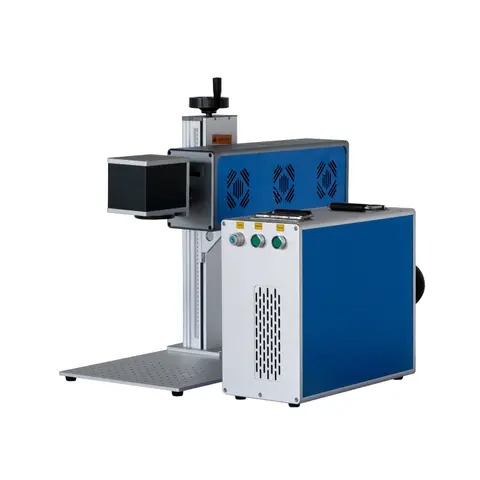
While the upfront cost of an RF-powered CO2 laser machine is higher, the total cost of ownership is significantly lower for Professional users.
When you factor in the lifespan (20,000 hours vs. 2,000 hours), the lack of downtime for replacements, and the higher processing speed due to beam quality, the RF source pays for itself. Furthermore, RF tubes can be "recharged" with new gas, whereas glass tubes are disposable waste. This makes the RF source a more sustainable and Eco-friendly choice for modern manufacturing.
What makes RF laser sources unique is their ability to bridge the gap between scientific precision and industrial ruggedness. Technologies like Transverse RF Discharge, Slab Waveguides, and Dielectric Barriers work together to create a beam that is sharper, faster, and more stable than anything a DC glass tube can produce. Whether you are running a High precision engraving business or a High power Industrial cutting facility, the RF source is the key technology that allows your CO2 laser machine to reach its full potential.
Generally, it is difficult because the mounting points, power supplies, and control signals are different. It is usually more cost-effective to purchase a Professional machine designed for RF from the ground up.
Low-power RF tubes (under 30W) can often be air-cooled. However, for Industrial applications above 60W, a Water cooled chiller is highly recommended to maintain the $M^2$ stability and longevity of the source.
Yes. Because the beam quality is higher and the spot size is smaller, an RF CO2 laser machine can often cut through thicker or denser materials more efficiently than a DC laser of the same rated wattage.
We have spent years analyzing the evolution of laser physics and its practical application in the B2B sector. At our company, we don't just assemble machines; we operate a high-tech manufacturing facility where quality and precision are at the heart of everything we do. We pride ourselves on our technical depth, ensuring that every CO2 laser machine we deliver is equipped with the most robust and efficient laser sources available. Our factory utilizes advanced testing equipment to calibrate each RF source, ensuring that the High precision and High power benchmarks we promise are met with absolute certainty.
Our strength lies in our ability to support Industrial clients with tailored solutions. We understand the demands of a high-volume CNC production environment, which is why we focus on durability and thermal stability. From the initial design of the metal cavity to the integration of the Water cooled system, we maintain total control over the manufacturing process. When you partner with us, you are not just buying a machine; you are gaining access to a team of experts dedicated to your long-term operational success.
